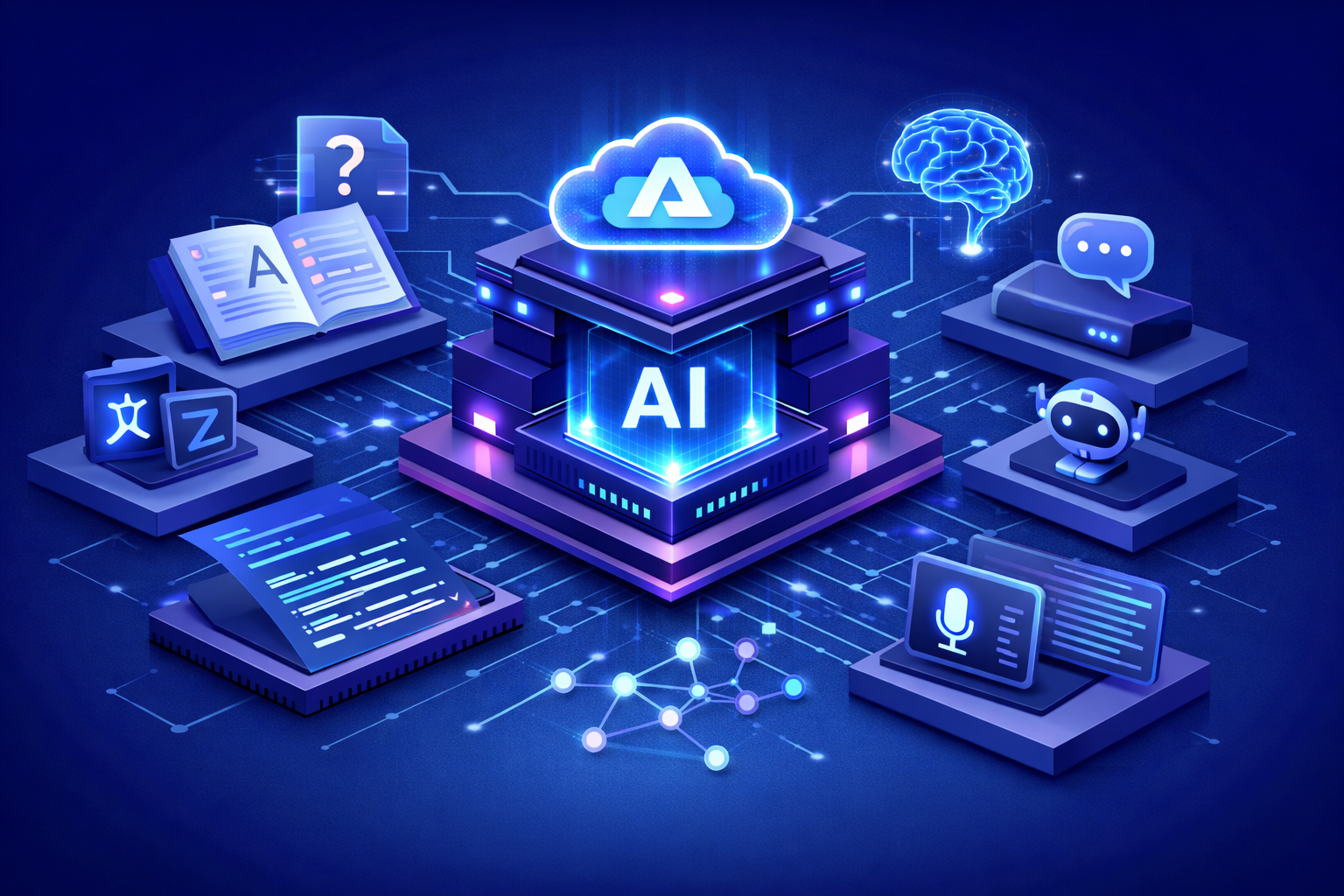
Understanding Azure AI Language
Azure AI Language is Microsoft Azure’s natural language processing service for understanding, analyzing, and extracting meaning from text. It is designed to help organizations interpret written language more effectively across a wide variety of scenarios, including customer interactions, support tickets, emails, reports, forms, documents, medical text, chat conversations, and internal knowledge repositories. Instead of treating text as raw content that must be reviewed manually, Azure AI Language allows organizations to analyze it as structured, machine-readable business information.
This capability is increasingly important because modern businesses generate enormous volumes of unstructured text every day. Valuable insights are often buried inside customer feedback, operational records, employee communications, legal documents, case notes, or service interactions. Azure AI Language helps bring structure and understanding to that text, making it easier to classify, summarize, search, route, govern, and use within broader digital workflows.
Why Language AI Matters in Modern Business
Unstructured text is one of the most important and underutilized assets in the enterprise. Organizations may have well-managed structured data in databases and line-of-business systems, but much of the real business context still exists in written language. Customer intent appears in service requests, product sentiment appears in reviews, risk indicators appear in contracts, health details appear in clinical notes, and operational issues appear in incident records. When that text is not analyzed effectively, important signals remain hidden.
Azure AI Language matters because it helps organizations move from manual reading and reactive interpretation to scalable, automated language understanding. It can improve productivity, support better decision-making, strengthen knowledge access, and enable more intelligent digital experiences. In many cases, it serves as the bridge between human communication and enterprise automation.
Core Capabilities of Azure AI Language
Azure AI Language includes a broad set of prebuilt and customizable capabilities that help organizations process text more intelligently.
-Sentiment Analysis and Opinion Mining: Detects whether text expresses positive, negative, neutral, or mixed sentiment and can identify sentiment linked to specific aspects or topics.
-Named Entity Recognition: Identifies entities such as people, places, organizations, dates, quantities, and other meaningful categories in text.
-Personally Identifiable Information Detection: Finds and can help redact sensitive personal information in written content.
-Summarization: Condenses long text into shorter, more usable summaries for quicker understanding and improved productivity.
-Conversational Language Understanding: Helps applications interpret intent and extract relevant details from user input in conversational scenarios.
-Custom Question Answering: Supports experiences where users can ask questions over a curated knowledge base and receive relevant answers.
-Text Analytics for Health: Extracts medically relevant concepts, relationships, and insights from healthcare-related text.
-Custom Text Classification and Custom Entity Extraction: Allows organizations to tailor models to their own categories, terminology, and business-specific language patterns.
From Text Processing to Language Understanding
The true value of Azure AI Language is not simply that it analyzes text. Its value lies in helping organizations understand language in a way that supports action. A support ticket can be classified and routed automatically. A set of reviews can be analyzed for sentiment trends. A document can be summarized for faster review. A conversation can be interpreted to identify intent. A medical note can be transformed into structured clinical insight. This is where language AI moves from analysis to operational impact.
This shift is especially important as organizations adopt more intelligent applications, AI assistants, and automated workflows. Language understanding becomes a foundational layer that allows systems to work more naturally with human communication. Instead of forcing people to adapt to rigid application structures, applications can better adapt to how people actually write and communicate.
Key Business Use Cases
Customer Feedback and Experience Analysis
Organizations can use Azure AI Language to analyze customer reviews, surveys, chat logs, social interactions, and service feedback. Sentiment analysis and opinion mining help teams understand how customers feel, what issues are recurring, and where products or services may need improvement. This creates a more scalable way to listen to customers and act on their concerns.
Support Ticket Classification and Routing
Service desks and customer support centers often manage large volumes of written requests. Azure AI Language can classify tickets, detect urgency, identify entities, extract key details, and help route requests to the right team or workflow. This improves responsiveness and reduces manual triage effort.
Conversational Applications and Digital Assistants
Azure AI Language plays an important role in conversational systems by helping applications understand what users want and what details matter. Intent recognition, entity extraction, and question-answering capabilities can improve virtual assistants, self-service applications, and internal support tools by making them more context-aware and useful.
Knowledge Management and Content Summarization
Enterprises often struggle with large amounts of documentation that are difficult to digest quickly. Azure AI Language can summarize reports, meeting notes, long-form communications, and operational documents so employees can understand key points faster. This helps reduce information overload and makes knowledge more accessible.
Healthcare and Regulated Text Analysis
In healthcare and similarly document-intensive sectors, written records often contain highly valuable but difficult-to-process information. Azure AI Language can support analysis of clinical notes, medical documents, and healthcare communications by identifying medically relevant concepts and relationships, helping organizations work with health-related text more effectively and at scale.
Prebuilt Intelligence and Customization
One of the strengths of Azure AI Language is that it supports both ready-to-use capabilities and tailored approaches. Many organizations can begin with prebuilt models for common scenarios such as sentiment analysis, named entity recognition, summarization, or PII detection. This accelerates adoption and allows teams to start generating value without building models from scratch.
At the same time, organizations often have specialized terminology, industry-specific categories, and unique document types that require customization. Azure AI Language supports this through custom text classification and custom entity extraction, allowing teams to align language AI with real business language and domain-specific requirements. This flexibility is important for moving from generic demos to production-ready enterprise solutions.
How Azure AI Language Fits into the Azure AI Ecosystem
Azure AI Language becomes even more powerful when it is integrated with other Microsoft Azure services. In many enterprise architectures, it acts as the language understanding layer within a broader intelligent application design.
-Azure OpenAI Service: Adds generative AI capabilities for summarization, conversational reasoning, drafting, and grounded text-based experiences.
-Azure AI Search: Uses extracted entities, metadata, summaries, and structured text to improve retrieval and knowledge discovery.
-Azure AI Foundry: Provides the broader platform for building, evaluating, and governing intelligent applications that include language understanding.
-Azure AI Agent Service: Enables agents to interpret user intent, retrieve context, and act on language-driven workflows.
-Azure AI Speech: Converts spoken language into text that can then be analyzed using language capabilities.
-Azure Translator: Supports multilingual scenarios where text must be translated before or after analysis.
-Azure AI Document Intelligence: Extracts text from documents that can then be classified, summarized, or analyzed through language AI.
-Azure Monitor, Key Vault, and Microsoft Entra: Support observability, security, access control, and secrets management across production deployments.
Language AI in Intelligent Applications
Azure AI Language is especially valuable in modern intelligent applications because text remains one of the main ways people communicate with systems. Whether users are typing questions, submitting support requests, writing notes, or working with long-form documents, language understanding helps the application interpret content more effectively and respond more intelligently.
In practical terms, this means Azure AI Language can serve as a foundational capability in enterprise copilots, internal knowledge assistants, service automation platforms, compliance workflows, and business applications that need to process large amounts of text reliably. It is not only a text analytics tool. It is part of the broader architecture that helps systems work with language in a more human-centered way.
Architecture Considerations for Production Solutions
A production-ready language AI solution usually involves more than sending text to an API. Teams should think carefully about content sources, document size, language coverage, processing patterns, latency expectations, model selection, security requirements, monitoring, and downstream workflow integration. These design decisions influence quality, usability, compliance, and long-term maintainability.
In many enterprise solutions, text is collected from forms, messages, applications, documents, or transcribed speech, then processed through Azure AI Language to generate insights such as sentiment, categories, entities, summaries, or extracted business meaning. Those outputs may then be routed into search indexes, dashboards, line-of-business systems, automation workflows, or AI agents. The architecture should reflect both the technical requirements and the business decisions that rely on the output.
Security, Privacy, and Responsible AI
Language processing can involve sensitive information, including customer records, employee communications, legal materials, operational notes, or medical content. For that reason, Azure AI Language should be implemented as part of a secure and governed architecture. Access control, secure integration, logging, data protection, and least-privilege design all play an important role in building trustworthy language-driven systems.
Responsible AI considerations are equally important. Language models and text analysis systems can produce errors or uneven outcomes if used without clear oversight. Organizations should validate results, define acceptable use boundaries, monitor quality over time, and keep humans involved where the business or regulatory impact of incorrect analysis is significant. The goal is not only to automate text understanding, but to do so responsibly and transparently.
Best Practices for Azure AI Language Adoption
-Start with a High-Value Text Scenario: Focus on business processes where large volumes of text create delay, inconsistency, or missed insight.
-Use Prebuilt Features First: Begin with standard capabilities such as sentiment analysis, entity recognition, summarization, or PII detection before adding customization where needed.
-Customize for Domain Relevance: Train custom classification and extraction models when business terminology or categories require deeper specialization.
-Integrate with Search and Workflow Systems: Treat language understanding as part of a broader process rather than as an isolated analytics feature.
-Validate Sensitive Use Cases: Keep human review in place where text analysis affects regulated decisions, legal interpretation, or high-impact business outcomes.
-Monitor Model and Feature Changes: Plan for versioning, ongoing quality checks, and service updates as language capabilities continue to evolve.
Common Challenges Organizations Should Address
Although Azure AI Language is highly capable, organizations should be prepared for practical challenges such as ambiguous text, inconsistent writing styles, domain-specific terminology, multilingual content, incomplete context, and variation in data quality. These issues are common in enterprise language processing and should be addressed through testing, customization, architecture design, and operational governance.
Another challenge is assuming language AI can replace business judgment completely. In reality, the strongest solutions often use Azure AI Language to accelerate understanding, improve routing, and surface insights while still preserving human accountability in sensitive or complex scenarios. Success depends on balancing automation with oversight.
The Strategic Value of Language Understanding
Azure AI Language creates strategic value by helping organizations unlock one of their richest and most difficult information sources: unstructured text. When businesses can interpret written language at scale, they improve their ability to listen to customers, support employees, automate communication-heavy workflows, strengthen compliance operations, and build more intelligent applications.
This matters because modern enterprises do not operate only on structured data. They operate on communication, documentation, context, and intent. Language understanding helps bridge that gap, making human-generated text more visible, more useful, and more actionable across the organization.
The Future of Azure AI Language
The future of Azure AI Language is closely connected to the broader shift toward intelligent, multimodal, and agent-driven applications. As enterprises increasingly combine generative AI, retrieval, workflow orchestration, speech, and document processing, language understanding will remain a core capability that helps systems interpret what people mean and how content should be handled.
Azure AI Language is well positioned for this future because it already supports both foundational text analytics and customizable business language solutions within the broader Foundry and Azure AI ecosystem. As organizations continue modernizing how they work with communication and content, language AI will become an even more critical layer in digital transformation.
Conclusion
Azure AI Language is unlocking meaning across unstructured text by helping organizations analyze sentiment, extract entities, summarize content, understand intent, answer questions, identify sensitive data, and interpret specialized business language at scale. With both prebuilt and customizable capabilities, it provides a strong foundation for modern language-driven applications and workflows. For organizations seeking to make written content more actionable, searchable, and intelligent, Azure AI Language represents a powerful and strategic component of the Microsoft Azure AI ecosystem.